

When another driver’s negligence kills a motorcyclist, Georgia law lets the rider’s family recover the full value of the life of the decedent, as shown by the evidence. That standard comes from the Georgia Wrongful Death Act, O.C.G.A. § 51-4-1 et seq.
Two problems dominate these cases in practice. The at-fault driver frequently carries far too little insurance, and the insurer almost always argues the rider caused their own death.
Hawk Law Group handles motorcycle accident and wrongful death claims throughout the Central Savannah River Area. This guide explains who may file, how Georgia’s helmet and lane statutes apply, where compensation may come from, and how physical evidence can help answer fault arguments when the rider cannot speak for themselves.
If your family lost someone in a motorcycle crash, speak with an Augusta wrongful death lawyer about preserving evidence, identifying every source of recovery, and protecting the claim from the start.
Why a fatal motorcycle claim is not just a car accident claim
The legal standard is the same, but the way these cases are defended is not. A motorcycle crash produces less physical evidence and invites more assumptions about the rider.
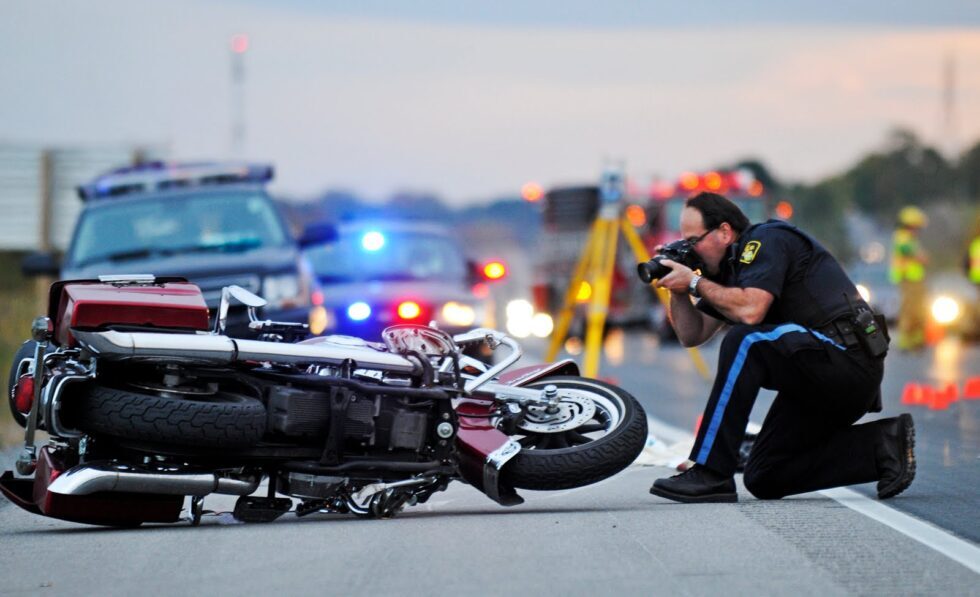
There is no crush pattern across a passenger compartment, usually no airbag control module on the motorcycle, and often no witness with a clear view. The evidence that survives is on the roadway itself.
Fatal motorcycle collisions in Georgia commonly involve a small set of driver errors:
- Left turns across the rider’s path: A driver turning left at an intersection or into a driveway misjudges the motorcycle’s speed and distance.
- Lane change and merge collisions: A driver changes lanes without checking a blind spot occupied by a motorcycle.
- Following too closely: A driver has no time to react when a motorcycle slows.
- Impaired or distracted driving: A driver not scanning for smaller profiles does not see the rider.
NHTSA’s motorcycle safety resources provide additional context on rider visibility, common crash risks, helmet use, and the challenges motorcyclists face when sharing the road with larger vehicles.
The second difference is assumption.
Fatal motorcycle claims frequently come with allegations that the rider was speeding, weaving, or taking risks. Those allegations should be tested against physical evidence rather than accepted as fact.
We will be candid that the bias runs in two directions, and both directions hurt a rider’s family. Some jurors arrive believing a person who rides accepted the risk of what happened, and that belief tends to move fault percentages upward before any evidence is discussed.
The other direction is quieter. The person at the defense table is usually an ordinary driver who made one terrible mistake, and jurors who do not want to ruin a decent person’s life often soften the number — frequently without knowing that a liability insurer, not the driver, is answering for the loss.
Neither problem is solved by argument. Both are answered with measurements, sight-line analysis, and proof specific enough to make an assumption hard to hold.
Who can file a Georgia wrongful death claim for a rider
Georgia does not let any grieving relative file. The statute sets a fixed order of priority.
Under O.C.G.A. § 51-4-2, the surviving spouse holds the claim for the full value of the life. If the spouse and children share the recovery, the spouse must receive no less than one-third of it.
If there is no surviving spouse, the claim belongs to the rider’s child or children, whether minors or adults. A separation before the claim arose is not a defense, and a spouse who later remarries does not lose the right.
If there is no surviving spouse or child, the rider’s parents may hold the claim under O.C.G.A. §§ 51-4-4 and 19-7-1(c). This applies whether the rider was a minor or an adult, although the rules for pursuing and dividing the recovery depend on the parents’ circumstances.
If there is no eligible spouse, child, or parent, O.C.G.A. § 51-4-5(a) allows the administrator or executor of the estate to bring the action and hold the recovery for the next of kin. The measure of damages does not change.
There is also a second, separate claim most families do not know about. Under O.C.G.A. § 51-4-5(b), the personal representative may recover funeral, medical, and other necessary expenses resulting from the injury and death, and Georgia law also allows the estate to recover the rider’s conscious pain and suffering before death.
An Augusta wrongful death attorney can help determine who holds the wrongful death claim and which additional claims must be brought through the estate.
The helmet statute is a causation question, not an automatic defense
Georgia has a universal helmet requirement. Under O.C.G.A. § 40-6-315, no person may operate or ride upon a motorcycle without protective headgear meeting standards set by the Commissioner of Public Safety, and the rule applies to operators and passengers alike with narrow exceptions.
An insurer may argue that violating the helmet statute reduces or defeats the claim. The violation does not automatically end the case.
Violating a safety statute is evidence a jury may consider on fault. It does not automatically eliminate a wrongful death claim, and it does not answer the question that actually matters.
The real question is causation — whether helmet use would have changed the outcome of this particular fatal injury. A rider killed by a chest or abdominal injury, or by a crash force no helmet is designed to absorb, presents a very different record than one killed by a head impact.
Autopsy findings, injury-mechanism analysis, and helmet-performance testimony may help answer that question. Medical experts and forensic specialists may be needed to determine whether helmet use could have changed the outcome.
Georgia’s 2025 tort reform law did not change the helmet rules. SB 68 amended O.C.G.A. § 40-8-76.1(d) so that failure to wear a seat belt is now admissible on negligence and comparative fault.
That provision addresses occupants of motor vehicles and does not create a new motorcycle standard. The helmet issue continues to be litigated as a causation and comparative-fault question on the facts of each case.
Where compensation may come from: minimum limits and UM coverage
This is often the single most consequential issue in a fatal motorcycle claim.
Georgia’s minimum auto liability limits are $25,000 for bodily injury per person, $50,000 per accident, and $25,000 for property damage. Some at-fault drivers carry no more than those minimum limits.
A fatal claim measured by the full value of a life is not a $25,000 case. The liability policy is a fraction of the loss.
O.C.G.A. § 33-7-11 · The coverage gap
This is often the single most consequential issue in a fatal motorcycle claim. Some at-fault drivers carry no more than Georgia’s minimum limits, and the liability policy is a fraction of the loss.
Measured without deducting the rider’s necessary or personal expenses had he lived — an economic half and an intangible half.
$50,000 per accident and $25,000 for property damage. Bar width is illustrative of the gap, not a scaled figure in any case.
The rider’s own UM/UIM coverage
Many riders carry UM on the motorcycle policy, and it can respond above the at-fault driver’s limits.
Other household policies
Depending on policy language and household relationships, UM coverage on other family vehicles may also apply.
How the UM limits apply
Whether UM limits stack on top of the liability payment or are offset by it depends on the policy, and it changes the total substantially.
Employer and commercial coverage
If the at-fault driver was working or driving a company vehicle, a commercial policy may apply.
Hit-and-run drivers
UM may apply when the vehicle cannot be identified. Georgia generally requires actual physical contact; without contact, the claimant’s account generally must be corroborated by an eyewitness other than the claimant under § 33-7-11(b)(2).
Protecting the UM claim
UM claims involve statutory notice, service, and release requirements. When a liability carrier tenders limits, a claimant generally must use a compliant limited release under § 33-24-41.1 — signing the wrong release can jeopardize the UM claim.
The at-fault driver may be entirely responsible and still have almost nothing to pay with. A judgment against a person with no assets and no coverage above the minimum can amount to paper — which is why the first work in a fatal motorcycle case is finding every party who had a duty and every policy that can respond.
That gap is why uninsured and underinsured motorist coverage matters so much.The Insurance Information Institute provides a useful overview of motorcycle insurance and UM/UIM coverage, including how uninsured and underinsured motorist coverage can respond when another driver has little or no liability insurance.
UM claims involve statutory notice, service, and release requirements. When a liability carrier tenders its policy limits, a claimant generally must use a compliant limited release under O.C.G.A. § 33-24-41.1 to preserve a pending UM claim. Georgia law does not allow a UM policy to require the carrier’s permission for a qualifying settlement with the liability carrier, but signing the wrong release can still jeopardize the UM claim.
This is where the difference between blame and recovery becomes concrete. The at-fault driver may be entirely responsible and still have almost nothing to pay with, and a judgment against a person with no assets and no coverage above the minimum can amount to paper.
So the first work in a fatal motorcycle case is finding every party who had a duty and every policy that can respond. UM coverage matters for exactly that reason.
Our attorneys locate and analyze every layer of available coverage before any settlement is discussed. Call (706) 539-5191 or reach us through our contact page.
Lane position, lane splitting, and who broke the rule
Adjusters frequently claim a rider was “weaving” or riding somewhere they should not have been. Georgia’s statute is more specific than that.
Under O.C.G.A. § 40-6-312(b), no person may operate a motorcycle between lanes of traffic or between adjacent lines or rows of vehicles. Lane splitting is illegal in Georgia.
The same statute recognizes something drivers routinely forget. Motorcycles are entitled to full use of a lane.
That cuts both ways in a fatal claim. A driver who crowds a rider’s lane, passes within the same lane, or drifts across the line is the party violating the statute.
Rider lane position is a safety practice, not a violation. Choosing a left or right track within the lane for visibility and escape room is normal riding, and it is not lane splitting.
How Georgia’s comparative fault rule applies
Georgia uses modified comparative negligence under O.C.G.A. § 51-12-33. Two provisions decide the outcome.
Under subsection (a), the judge reduces the damages in proportion to the decedent’s percentage of fault. Under subsection (g), there is no recovery at all if the person is found 50 percent or more responsible.
Example: Suppose a jury sets the full value of a rider’s life at $1,500,000 and assigns the rider 25 percent of the fault for traveling above the posted speed. The award is reduced to $1,125,000. If the jury had assigned 50 percent instead, the family would recover nothing.
That cliff explains why insurers push fault percentages so hard in fatal motorcycle cases. Moving a jury from 45 percent to 50 percent is worth the entire claim to them.
This is the real battleground, and in a fatal motorcycle case it is unusually one-sided at the start. The record on the rider’s speed and lane position has to be reconstructed from physical evidence, because the person who could describe it is gone.
We walk into these cases expecting that fight rather than reacting to it. The record gets built specifically to keep the rider’s share below the line — reconstruction measurements, the other driver’s sight lines and signal timing, and the physical evidence of where each vehicle actually was.
Georgia generally apportions damages among independently liable people and companies according to their percentages of fault under O.C.G.A. § 51-12-33(b). Limited exceptions may apply, including claims based on concerted action or purely vicarious liability, so a defendant is not necessarily limited to a separately assigned share in every case.
Proving the case when the rider cannot testify
In a fatal motorcycle claim, the person with the clearest view of what happened is gone. The case is rebuilt from what the roadway and the machines recorded.
O.C.G.A. § 51-12-33 · Rebuilding the record
In a fatal motorcycle claim the person with the clearest view of what happened is gone. Fatal claims frequently come with allegations that the rider was speeding or weaving, and those allegations should be tested against physical evidence rather than accepted as fact.
Speed and angle
Final rest positions
Where the motorcycle, the rider, the other vehicle, and the debris field came to rest supports speed and angle-of-impact analysis.
Point of impact
Gouge, scrape, and yaw marks
Metal contact with pavement marks the point of impact far more precisely than skid marks alone.
Injury mechanism
Helmet and gear damage
Impact locations on headgear, jacket, and boots help establish injury mechanism and body movement.
The left-turn case
Sight lines and turn geometry
Measured sight distances, obstructions, signal timing, and approach speeds show what the turning driver could actually see and when.
Stored data
Vehicle data and phone records
Many passenger vehicles store pre-impact speed and braking data, and phone activity can establish distraction.
§ 40-6-312(b) and § 40-6-315
Which rule was actually broken
Motorcycles are entitled to full use of a lane — a driver who crowds the lane or passes within it is the party violating the statute. Choosing a track within the lane is a safety practice, not lane splitting. A helmet violation is a causation question, not an automatic defense.
Georgia uses modified comparative negligence. Under subsection (a) the judge reduces damages in proportion to the decedent’s percentage of fault. Under subsection (g) there is no recovery at all at 50 percent or more.
Rider 25% at fault
Full value of the rider’s life$1,500,000
Reduction for the rider’s fault−$375,000
$1,125,000
Reduced in proportion — here, for traveling above the posted speed.
Rider 50% at fault
Full value of the rider’s life$1,500,000
Statutory bar — § 51-12-33(g)Recovery barred
$0
The family recovers nothing.
That cliff explains why insurers push fault percentages so hard: moving a jury from 45 percent to 50 percent is worth the entire claim to them. So the record gets built specifically to keep the rider’s share below the line — reconstruction measurements, the other driver’s sight lines and signal timing, and the physical evidence of where each vehicle actually was.
An Augusta motorcycle accident lawyer can investigate the crash itself, including vehicle data, roadway evidence, sight lines, witness accounts, and other evidence used to reconstruct how the collision happened.
One category families rarely think to mention is what happened after the collision. Whether the driver stopped, called for help, stayed at the scene, or left, and what the driver said and did in the days that followed, often carries more weight with a jury than the mechanics of the impact.
That is not sentiment; it is how people decide things. Juries tend to make a character assessment first and apply the legal standard second, so after-the-fact conduct is gathered and documented like any other evidence.
This work has a short shelf life. Roadway markings fade, vehicles are repaired or sold for salvage, and video from nearby businesses is routinely overwritten within weeks.
When appropriate, accident reconstruction may help explain how the collision happened. Early preservation demands can also help protect physical and digital evidence before it is altered, destroyed, or overwritten.
Damages available to a rider’s family
The wrongful death claim recovers the full value of the life, which O.C.G.A. § 51-4-1 measures without deducting the rider’s necessary or personal expenses had he lived. It has an economic half built from wages, benefits, and household services, and an intangible half covering everything the rider would have experienced by continuing to live.
Under O.C.G.A. § 51-4-2(e), that recovery is not subject to any debt or liability of the rider or the estate. The separate estate claim covers funeral and medical expenses plus conscious pre-death pain and suffering.
Punitive damages are not available as part of the statutory wrongful death claim. A properly appointed personal representative may seek them through a separate estate or survival claim when the evidence satisfies O.C.G.A. § 51-12-5.1.
Punitive damages require clear and convincing evidence of willful misconduct, malice, fraud, wantonness, oppression, or an entire want of care raising a presumption of conscious indifference to consequences. There is generally a $250,000 cap under subsection (g), but subsection (f) removes that cap when the defendant acted with specific intent to cause harm or acted while under the influence of alcohol or qualifying drugs. The exception removes the cap; it does not eliminate the required proof.
Deadlines that control the claim
Georgia’s limitation period for wrongful death is two years under O.C.G.A. § 9-3-33, measured from the date of death.
Several rules can change that date:
- Pending criminal prosecution: Under O.C.G.A. § 9-3-99, the period is tolled while a prosecution arising from the same conduct is pending, up to a maximum of six years.
- No estate representative appointed yet: O.C.G.A. § 9-3-92 does not count time before an estate representative is appointed, up to five years, for claims belonging to the estate.
- Government defendants: If a city, county, or state entity may share fault for a road or signal condition, a much earlier written ante litem notice is required.
The filing deadline is rarely what costs a family the case, though. The motorcycle is released from the impound lot and sold or scrapped, gouge and yaw marks wash away with a few rains, and the people who stopped at the scene move, change numbers, and forget which lane the truck was in.
Tolling rules can extend the time to file without preserving a single piece of that proof. The decay of the evidence is the real clock, and it starts the day of the crash.
What our attorneys watch for
Some of what decides a fatal motorcycle claim has little to do with the statutes above. These are patterns we watch for in the first weeks.
- The early call from an adjuster is not customer service: A friendly call offering to get everything resolved quickly is a trained professional building a record. A recorded statement can weaken a claim even when every word of it is true, because a family does not yet know the full scope of the loss and anything minimized early becomes leverage later.
- Riding photographs get used to characterize the rider: Rally pictures, group ride videos, and a photo of a bike leaned into a curve are exactly what an investigator looks for, because they support the assumption a jury may already carry. Do not delete existing posts, because removing them can become its own issue in the case, and platforms answer subpoenas with the content and the timestamps. The better step is to stop posting about the loss or the claim, and to tell us what is already out there.
- Context has to reach the jury before the image does: Once jurors see a photograph, an explanation can follow it all day and the picture stays, so we would rather know what exists early and present the rider’s real history ourselves. A licensed, trained, experienced rider is a different story than the one an insurer will otherwise tell.
- Strong claims are lost quietly: What we see is waiting — speaking with insurers alone, letting the bike be released and the marks fade, and settling with the liability carrier before UM rights are protected. None of those feel like decisions at the time, which is why we would rather look at them early than late.
If an adjuster has already called or asked for a statement, call (706) 539-5191 or reach us through our contact page first.
How our team can help
A fatal motorcycle claim is won on two fronts — physical evidence that answers the fault argument, and a coverage investigation that finds every policy that can respond. Both have to start early.
Our attorneys at Hawk Law Group bring more than 71 years of combined legal experience to wrongful death claims, with five staffed offices serving Augusta, Evans, Thomson, Waynesboro, and Aiken. We work with medical and forensic specialists when appropriate, and we handle these cases on a contingency fee basis, so there is no upfront cost and no fee unless we recover.
Call (706) 539-5191 or reach out through our contact page. Home and hospital visits are available, and se habla español.
Frequently Asked Questions
Does not wearing a helmet hurt our claim? +
It can be raised, but it is not an automatic bar. Georgia requires helmets under O.C.G.A. § 40-6-315, and an insurer will argue the violation as comparative fault.
The question that matters is whether helmet use would actually have prevented this fatal injury. Where the cause of death was not a head injury, that is central to how the argument is answered.
What if the at-fault driver does not have enough insurance? +
That is common, since Georgia's minimum bodily injury limit is $25,000 per person. Recovery then depends on uninsured and underinsured motorist coverage on the rider's own policy and potentially other household policies, plus any employer or commercial coverage if the at-fault driver was working.
Can we recover if the rider was partly at fault? +
Yes, up to a point. Under O.C.G.A. § 51-12-33 the award is reduced by the rider's percentage of fault, and there is no recovery if the rider is found 50 percent or more responsible.
How long do we have to file? +
Two years from the date of death under O.C.G.A. § 9-3-33, subject to tolling for a pending criminal prosecution under § 9-3-99 and the estate representative rule in § 9-3-92. Claims involving a government entity require written notice far sooner.
Is lane splitting legal in Georgia? +
No. O.C.G.A. § 40-6-312(b) prohibits operating a motorcycle between lanes of traffic or between adjacent lines or rows of vehicles.
The same statute confirms that motorcycles are entitled to full use of a lane. A driver who crowds a rider inside that lane is the party breaking the rule.
Can we recover punitive damages if the driver was drunk? +
Possibly, through a separate estate or survival claim brought by the personal representative. Punitive damages are not part of the statutory wrongful death claim.
They still require clear and convincing evidence under O.C.G.A. § 51-12-5.1. Subsection (f) removes the usual $250,000 cap when the defendant acted while under the influence of alcohol or qualifying drugs, but it does not remove the burden of proof.
The insurance company keeps bringing up how fast the rider was going — how do we fight that? +
With physical evidence rather than argument. Speed is calculated from gouge and yaw marks, final rest positions, the debris field, crush damage on the other vehicle, and any stored pre-impact data from that vehicle, and those measurements are frequently the first independent test of the speed figure being argued.
Speed also is not the end of the question. Under O.C.G.A. § 51-12-33 the issue is the percentage of fault assigned, so the other driver's sight lines, signal timing, and failure to yield are developed at the same time to keep the rider's share below the 50 percent bar.