


A bicycle gives you freedom, fresh air, and almost no protection. When a rider hits the pavement, a car door, or the hood of an SUV, there is no steel frame and no airbag between you and the impact.
That is why internal injuries are so common after a bike wreck, and the spleen is one of the first organs to pay the price. The cruel part is the timing. Some riders feel fine at the scene, then start bleeding internally hours or days later.
If you or someone you love went down on a bike and felt any belly pain afterward, treat it as an emergency and get to a doctor. Once you are safe, talk to a bicycle accident lawyer, because from the moment you are hurt, the driver’s insurance company is already working against you.
One thing we tell injured cyclists early: after a bike-versus-vehicle crash, you are not really dealing with the driver. You are dealing with the driver’s insurance carrier, and that company is looking for reasons to pay you less.
What Is the Spleen and Why Is It Vulnerable in Bike Accidents?
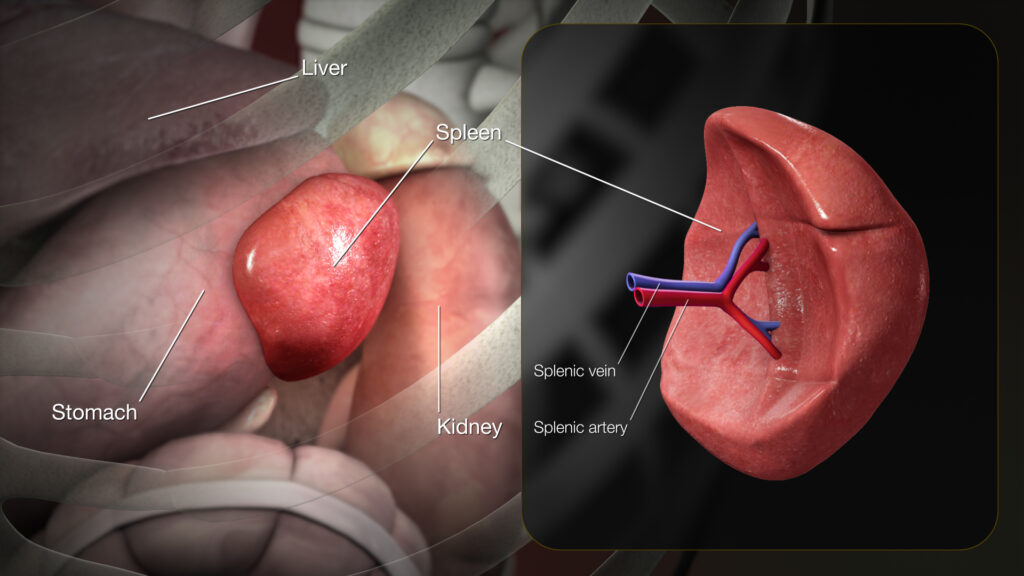
The spleen is a fist-sized organ in the upper left side of your abdomen, tucked just under the rib cage. It filters your blood and supports your immune system, and it holds a rich supply of blood — which is exactly what makes it dangerous when it tears.
On a bike, there is nothing shielding that organ from a direct hit. A few common ways a crash reaches the spleen:
- Handlebar impact: Getting thrown forward can drive the handlebars straight into the left side of your abdomen.
- Ground impact: Landing on pavement compresses the organs in your upper belly.
- Vehicle contact: A car or truck striking your left side delivers force your body has no way to absorb.
In a car, a frame and airbags soak up some of that energy. On a bike, your body is the crumple zone.
How Common Are Spleen Injuries After a Bike Accident?
Spleen injuries are among the most frequent abdominal injuries in any blunt-force trauma, and cycling is a blunt-force sport by nature. Because a rider has no barrier between the body and the road, forces that a car would partly absorb land directly on soft internal organs.
Bike crashes are less common than car crashes overall, but the rate of serious abdominal injury per crash runs higher for cyclists. The reason is simple: your torso, not a vehicle, takes the hit.
Here is what the national picture looks like, according to the National Highway Traffic Safety Administration:
| Bicycle crash reality in the U.S. | Figure |
|---|---|
| Cyclists injured in traffic crashes (2023) | ~49,989 |
| Cyclists killed in traffic crashes (2023) | 1,166 |
| Increase in cyclist injuries since 2020 | +28.6% |
| Share of cyclist deaths at non-intersections (2019–2023) | 62.7% |
| Bike crashes possibly missing from police data | up to 46% |
That last row matters more than people realize. Researchers estimate that a large share of bicycle crashes never make it into a police report at all — which means the official record of your crash may be thin, and thin records are easy for an insurer to attack.
Anyone who goes down hard on a bike should treat belly pain or tenderness as a possible emergency, even when every other injury looks minor. If you have been hurt while riding in the CSRA, our Augusta bicycle accident team is available 24/7 — call (706) 539-5191 for a free consultation.
Types of Spleen Injuries from Bicycle Accidents
Not every spleen injury is the same, and the differences decide everything about your treatment and your recovery.
Bruised (contusion) spleen
A contusion is bruising without a tear. The blood vessels inside are damaged, but the organ stays intact, and many contusions heal with rest and monitoring. It is the least severe form — but it still needs a doctor’s eyes on it.
Lacerated or torn spleen
A laceration is an actual tear in the tissue, ranging from a shallow surface cut to a deep injury that reaches major blood vessels. Moderate to severe tears often mean hospitalization, and some require surgery.
Ruptured spleen — a medical emergency
A rupture is the worst case. Blood floods the abdomen quickly, and without fast surgical care the blood loss can lead to shock, organ failure, and death.
Doctors grade spleen injuries on a scale from I to V. The higher the grade, the more aggressive the treatment and the greater the risk:
| Grade | What it means | General severity |
|---|---|---|
| I | Small surface tear or bruise, minimal bleeding | Least severe |
| II | Deeper tear, bleeding still contained | Mild to moderate |
| III | Deep laceration reaching blood vessels | Serious |
| IV | Major laceration with significant blood loss | Severe |
| V | Shattered spleen or torn blood supply | Life-threatening |
Symptoms of a Spleen Injury After a Bike Accident
Some spleen injuries announce themselves right away. In the hours after a crash, watch for pain or tenderness in the upper left abdomen, left-side rib pain, dizziness, nausea, a racing heartbeat, or paleness. If any of these appear, go to the emergency room — and do not drive yourself.
The far more dangerous scenario is the quiet one. Blood can pool beneath the spleen’s outer covering for hours or days before it releases into the abdomen — a subcapsular hematoma — so a rider can feel fine at first and then crash medically without warning.
Delayed warning signs — treat these as a 911 emergency:
- Belly pain that gets worse over hours or days
- Left shoulder pain (called Kehr’s sign — internal bleeding irritating the diaphragm)
- Fainting or sudden loss of consciousness
- Confusion or feeling “off”
- Dizziness that worsens when you stand
If any of these hit in the days after a bike accident, do not wait it out. Call 911 or have someone drive you to the nearest ER immediately.
This delay is not just a medical problem. As you will see next, it is the exact window the insurance company uses against you. Before you say a single word to an adjuster, talk to our team at (706) 539-5191.

Why the adjuster calls before your body knows it’s hurt
Here is a pattern we see over and over. A friendly adjuster calls a day or two after the crash, sounds genuinely helpful, and offers to “get this resolved quickly.”
That call is not customer service. It is a trained professional documenting your words before you know the full extent of your injuries.
Now put that next to what you just learned about the spleen. Your worst injury may not have surfaced yet — the internal bleeding is still building — and you are being asked to describe how you feel on a recorded line. Anything you downplay early, even saying you feel okay, becomes ammunition once a later scan shows a splenic laceration.
So we tell every injured cyclist the same thing. Do not give a recorded statement, and do not accept a quick settlement, until your medical picture is complete.
An invisible injury is an insurer’s favorite kind
A spleen injury does not show on the outside. There is no cast and no visible wound — and insurers know how to use that.
When there is real money on the table, carriers investigate, and that investigation almost always includes your social media. One cheerful photo, one check-in, one event a family member tagged you in can be spun into an argument that you are “fine,” even while you are healing from a ruptured organ.
The math is cold and predictable. Nobody hires an investigator over a minor claim, but on a serious injury worth six or seven figures, spending a few thousand dollars to find one damaging photo is an easy business decision for them.
A few things worth knowing while a claim is open:
- Deleting posts does not erase them: Platforms keep records and hand them over in discovery, sometimes with dates and device details.
- A private profile is not enough: Investigators look at your spouse’s page, your kids’ accounts, and anyone who might tag you.
- The strongest cases post the most: People who were genuinely wronged are the angriest and the most tempted to share — and that is often how a real claim gets picked apart.
The defense does not need to prove you faked anything. It only needs to plant enough doubt to justify paying less, which is why we ask clients to go quiet online. If a carrier is already circling your claim, call us at (706) 539-5191 before you post another word.
How Are Spleen Injuries Diagnosed and Treated?
Diagnosis
Emergency doctors have reliable tools for spotting splenic damage. A CT scan with contrast is the gold standard for finding the injury and grading it, a FAST ultrasound quickly checks for free fluid at the bedside, and a physical exam looking for tenderness or guarding tells the team when to image further.
That CT scan does something a lawyer cares about, too. It creates a time-stamped record that links the internal injury directly to the collision — a fact that becomes hard for any insurer to argue with later.
Treatment options
What happens next depends on the grade of the injury and how stable you are:
- Observation: Minor injuries in stable patients are often watched closely in the hospital without surgery.
- Angioembolization: Specialists can sometimes stop the bleeding without an open operation.
- Surgery: Severe injuries or ongoing bleeding may require repair — or removal of the spleen entirely (a splenectomy).
Recovery ranges from a few weeks for a minor injury to several months after surgery. And losing a spleen carries a lifelong, elevated risk of certain infections, which is one reason these cases are worth far more than a quick settlement suggests.
When a Georgia bike crash becomes a legal case
A crash that damages your spleen can become a personal injury claim when someone else’s carelessness caused it. Common examples include a driver who failed to yield, ran a red light, or was distracted; a hazard the city failed to fix; or a driver who opened a door into your path.
Picture a rider heading home at dusk when a driver turns right across the bike lane without looking. The cyclist goes over the handlebars, feels bruised but “okay,” and waves off the ambulance — then collapses at work two days later with a slowly bleeding Grade IV laceration. That is a textbook negligence claim, and a textbook example of why the early “I feel fine” almost cost him everything.
If negligence caused your crash, you may be owed compensation for medical bills, lost wages, future care tied to your injury, and pain and suffering. The value also depends heavily on the specific injuries involved. For example, our guide to the average settlement for a broken sternum explains how injury severity, treatment, and long-term effects can influence compensation.
The rules cyclists are expected to follow can also affect how fault is divided after a crash. Riders across the state line can review our guide to the bicycle laws cyclists need to know in South Carolina and how those rules can affect an accident claim.
One Georgia rule can end your case, so it deserves attention. Under the state’s modified comparative negligence law (O.C.G.A. § 51-12-33), you can recover only if you are found less than 50% at fault. Hit 50%, and you recover nothing — which is exactly why the defense works to shift blame onto the rider.
The deadline is just as unforgiving, and it changes at the state line the CSRA straddles:
| Georgia | South Carolina | |
|---|---|---|
| Deadline to file a personal injury claim | 2 years (O.C.G.A. § 9-3-33) | 3 years (S.C. Code § 15-3-530) |
Miss that window by a single day, and even a strong case is gone. Before the clock runs or an adjuster locks in your words, talk to our Augusta attorneys at (706) 539-5191.
Where the money actually comes from
Winning is only half the job. A claim is worth something only if someone can actually pay it, so one of the first things we look at is every possible source of recovery.
That means the driver’s policy and, just as often, your own uninsured or underinsured motorist coverage — a source many injured cyclists never realize they can use. We also move fast on evidence, because it decays. Your damaged bike, your helmet, the vehicle, scene photos, and witness memories are all most reachable in the days right after the crash.
What Should You Do If You Suspect a Spleen Injury?
If you were in a bike accident and have any reason to think you are hurt inside, a few steps protect both your health and any future claim:
- Go to the ER now: Do not wait to see if the pain fades.
- Do not minimize symptoms: Belly tenderness after a crash earns a scan.
- Follow up after discharge: Symptoms that worsen at home mean you go back immediately.
- Save everything: Medical records, imaging, and physician notes are the backbone of any claim.
- Avoid strenuous activity: Rest restrictions exist to prevent a delayed rupture.
Early diagnosis is the line between a manageable injury and a life-threatening one. Getting the right medical and legal help early keeps that line on your side.
How a Georgia Bicycle Accident Lawyer Can Help
Internal injuries do not always announce themselves. A cyclist can walk away from a crash and be bleeding the whole time, which is why any belly pain, left shoulder pain, dizziness, or weakness in the days after a wreck calls for emergency care.
Once you are treated, let us handle the rest. Spleen injuries bring high medical bills, weeks or months away from work, and lasting complications — and you have the right to pursue full compensation from whoever caused the crash.
We represent cyclists throughout the CSRA on a contingency fee basis, which means no upfront cost and no fee unless we recover for you. Our phones are answered 24 hours a day, seven days a week.
Get a free consultation today — call (706) 539-5191 or reach us through our contact page.
Frequently Asked Questions
How long after a bike accident can spleen injury symptoms appear? +
Symptoms of a spleen injury can appear immediately or be delayed for 24 to 72 hours or more after a bicycle crash. This delay occurs when blood pools beneath the spleen’s outer lining before releasing. Worsening abdominal pain, left shoulder pain (Kehr’s sign), fainting, or confusion after a crash are warning signs that require emergency evaluation, even days later.
Can a spleen injury heal on its own? +
Minor splenic contusions and low-grade lacerations in stable patients are sometimes managed non-operatively with rest and monitoring. However, “healing on its own” requires hospital-level monitoring and imaging to confirm stability — it does not mean ignoring symptoms at home. Moderate to severe injuries, and any injury with ongoing bleeding, require medical intervention. A physician must determine whether observation or surgery is appropriate.
Is a ruptured spleen life-threatening? +
Yes. A ruptured spleen causes rapid internal bleeding that can lead to hypovolemic shock, organ failure, and death without prompt surgical treatment. It is one of the most serious outcomes of blunt abdominal trauma. Anyone experiencing severe abdominal pain, faintness, or rapid deterioration after a bicycle accident requires emergency medical care immediately.
Should I see a doctor after a minor bike accident? +
Yes. Even crashes that seem minor can cause internal injuries that are not immediately apparent. The delayed symptom pattern of splenic injuries means that feeling okay immediately after a crash does not rule out serious internal trauma. Seeking medical evaluation after any significant impact — even without obvious injury — is the safest course of action and protects both your health and any potential legal claim.